From Cost Center to Value Engine
Bridging the Gap Between Supply Chain Operations and Economic Value Added (EVA)
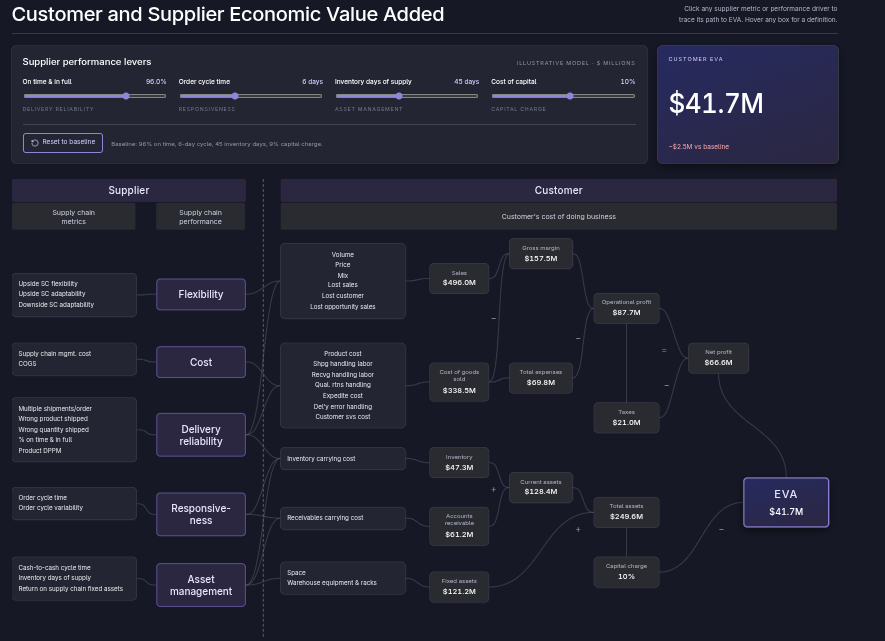
For decades, a language barrier has existed between the supply chain leader and the CFO. The supply chain team speaks in terms of fill rates, cycle times, and flexibility. The finance team speaks in terms of Return on Invested Capital (ROIC) and Economic Value Added (EVA).
Too often, supply chain is viewed strictly as a cost center, a necessary expense to be minimized. But when we map supply chain performance metrics directly to the corporate balance sheet, a different picture emerges. A high-performing supply chain is not just about saving pennies on logistics; it is a primary driver of true economic value.
To understand this, we must look beyond standard profit margins and utilize Economic Value Added (EVA) as our North Star.
The EVA Equation: The Universal Translator
At its core, EVA measures the true profit of a company after accounting for the cost of the capital invested to generate that profit. The formula is deceptively simple:
To maximize EVA, a company must do one of two things:
1. Increase the Numerator
Drive more profit through sales growth or cost reduction.
2. Decrease the Denominator
Reduce the assets (inventory, warehouses, equipment) required to run the business.
Most supply chain strategies focus only on the first (cost reduction). However, a sophisticated supply chain strategy pulls levers on both sides of this equation simultaneously. Here is how the connection works.
1. The Numerator: Driving Growth through Flexibility and Reliability
In the world of EVA, revenue is not just a sales function; it's a supply chain function.
Flexibility as a Revenue Driver
Traditionally, flexibility is seen as an operational safety net. But in an EVA model, Upside Supply Chain Flexibility, the ability to respond rapidly to additional demand, directly impacts the top line. If demand spikes and the supply chain can pivot to meet it, the company captures sales volume and market share that would otherwise be lost. This increases Gross Margin and Operational Profit, directly inflating the EVA numerator.
Reliability Protects the Top Line
Delivery Reliability (often measured as "Perfect Order Fulfillment") is critical. Poor reliability bleeds value through lost customers and lost sales opportunities. By ensuring the right product arrives at the right time, the supply chain protects the "Volume, Price, and Mix" drivers of revenue.
2. The Denominator: Freeing Cash through Responsiveness and Asset Management
This is where the supply chain becomes a strategic asset. Every dollar tied up in inventory or warehouse space is a dollar that creates a "Capital Charge", a penalty against EVA.
Responsiveness Reduces the Burden of Inventory
There is a direct mathematical link between speed and capital. By improving Responsiveness(reducing order cycle time and variability), we reduce the need for safety stock. Faster cycles mean less inventory sitting idle. Less inventory means reduced Current Assets. A lower asset base reduces the Capital Charge, automatically boosting EVA even if profit margins stay flat.
Sweating the Assets
Asset Management efficiency, often described as "sweating the assets", looks at how effectively we utilize fixed assets like manufacturing lines, warehouses, and staff. If we can do more with less space and equipment, we reduce Fixed Assets. This shrinks the denominator of our equation, increasing the return on every dollar invested.
The "Double Impact" of Performance
Perhaps the most powerful insight from this model is the interconnected nature of these metrics. Take Delivery Reliability as a prime example. It is a "swing factor" that impacts both sides of the EVA equation:
It Increases Revenue
By avoiding lost sales and dissatisfied customers.
It Decreases Assets
When reliability is high, the organization trusts the chain. It stops hoarding "just in case" inventory, reducing the capital charge.
Conclusion: The Strategic Shift
It is time to stop viewing supply chain metrics in a vacuum.
Flexibility
is not just about agility;
it is about Revenue Capture
Responsiveness
is not just about speed;
it is about Working Capital Reduction
Asset Management
is not just about utility;
it is about Investment Efficiency
By linking operational metrics (SCOR) to Economic Value Added, we transform the supply chain from a cost to be managed into a value engine to be optimized.
We move from asking "How much did we spend?" to "How much value did we create?"
Ready to Calculate Your SCOR-to-EVA Impact?
Use our interactive SCOR-to-EVA Calculator to input your own revenue and asset figures and simulate how improvements in flexibility, responsiveness, or reliability would impact your bottom line.